A Brownville audience was informed Saturday morning, Aug. 8 that a couple of factors led Mari Sandoz to pursue a writing career.
“I had all of these words inside of me I had to get out and lots of siblings to support,” Peg Gilbert noted in a firsthand Humanities Nebraska presentation.
The eldest of six children, Marie Susette Sandoz used Marie McCumber on her early work before transitioning to a “good writers name” and grew fond of Mari.
Sandoz’ father, Jules, emigrated from Switzerland settling in the Verdigre area of northeast Nebraska in the early 188os. Crops did not produce well in the Niobrara River Valley. Gilbert stated Jules was attracted to Nebraska by free land available through the Homestead Act and wanted to bring the entire family to the United States. The family moved to the Sandhills under the 1904 Kincaid Act, which increased land allotments to 640 square acres in 37 dry counties of the Nebraska Sandhills. Gilbert noted Jules planted a new orchard under improved soil conditions.
Jules had four wives, his fourth, Mary Fehr, was the mother of all of the children. Gilbert related Jules preferred the company of Native Americans over cattlemen. His goal was to build an orchard because it reminded Jules of his homeland and wanted to prove orchards can thrive.
Mari Sandoz was home schooled until age 9, spoke German, attended school through eighth grade, passed the rural teacher examination at age 17 and taught in Nebraska schools until age 21. A prolific reader, she was only allowed to take nonfiction books home. Her first story, Broken Promise, was published at age 10 in the Omaha Daily News, which was published from 1899 through 1927.
Sandoz moved to Lincoln in October 1919, learned typing and shorthand and eventually attended the University of Nebraska. She later became an associate editor of Nebraska history at the Nebraska State Historical Society. While in Lincoln Sandoz started research on Old Jules, about her father.
“His request became my duty,” Gilbert related, noting Sandoz received a lot of rejection slips on her work. The author revised the book, submitted it to the Atlantic Monthly and won a prize in a contest. Old Jules, published in 1935, is considered the definitive story of homesteading in western Nebraska. Gilbert noted Old Jules was a Book of the Month Club selection and among six books forming the center of Sandoz’ work.
Concerns of Old Jules reappear in the author’s later books: the rights of the poor, the dispossessed and those facing discrimination.
Referred to as her Great Plains Series, the others are: The Beaver Man, The Buffalo Hunters, The Cattle Man, Crazy Horse and Cheyenne Autumn. While she had completed much of the research, only her death in March 1966 kept Sandoz from writing the seventh and last work.
After hearing of backroom politics occurring in Lincoln and wanting the public to know about it, Gilbert stated Sandoz wrote Capital City, which focused on the possibility of a fascist movement in the United States. Gilbert thought it was “great” allowing Capital City to be adapted in a stage production which was presented in Auburn and other Nebraska cities last spring.
Sandoz was able to write Crazy Horse, published in 1942, because Jules was a friend of Native Americans. Gilbert related Sandoz reworked it to tell the story the way Natives told it. The presenter espoused Crazy Horse was called “a towering achievement in her chronicles of the West.”
Sandoz later lived in New York City where she did research but taught summers at the University of Wisconsin to escape the heat in the nation’s largest city, Gilbert said. Sandoz was part of a group who discussed frontier history and was tough on facts, the presenter noted.
Gilbert indicated Sandoz’ biggest regret was allowing Cheyenne Autumn to be filmed. The 1964 Western was directed by John Ford, the only four-time Oscar-winning director. The author thought the screenwriter (James R. Webb, who won an Oscar from How the West Was Won) “destroyed the story and its meaning.” Sandoz told Warner Bros. it was to be credited as “suggested by her book.”
Sandoz wrote 27 books and earned many awards, including an honorary doctorate from the University of Nebraska. Her last volume was The Battle of the Little Bighorn. Sandoz was buried in the Sandhills overlooking the family orchard. In 1976 she was inducted into the Nebraska Hall of Fame.
Gilbert concluded her presentation with two thoughts from Sandoz to “have two things only. Not fame, riches or great beauty, but the courage to follow your dream and a love of great reading.”
Ad

Accomplishments of Nebraska Author Mari Sandoz Presented at Brownville
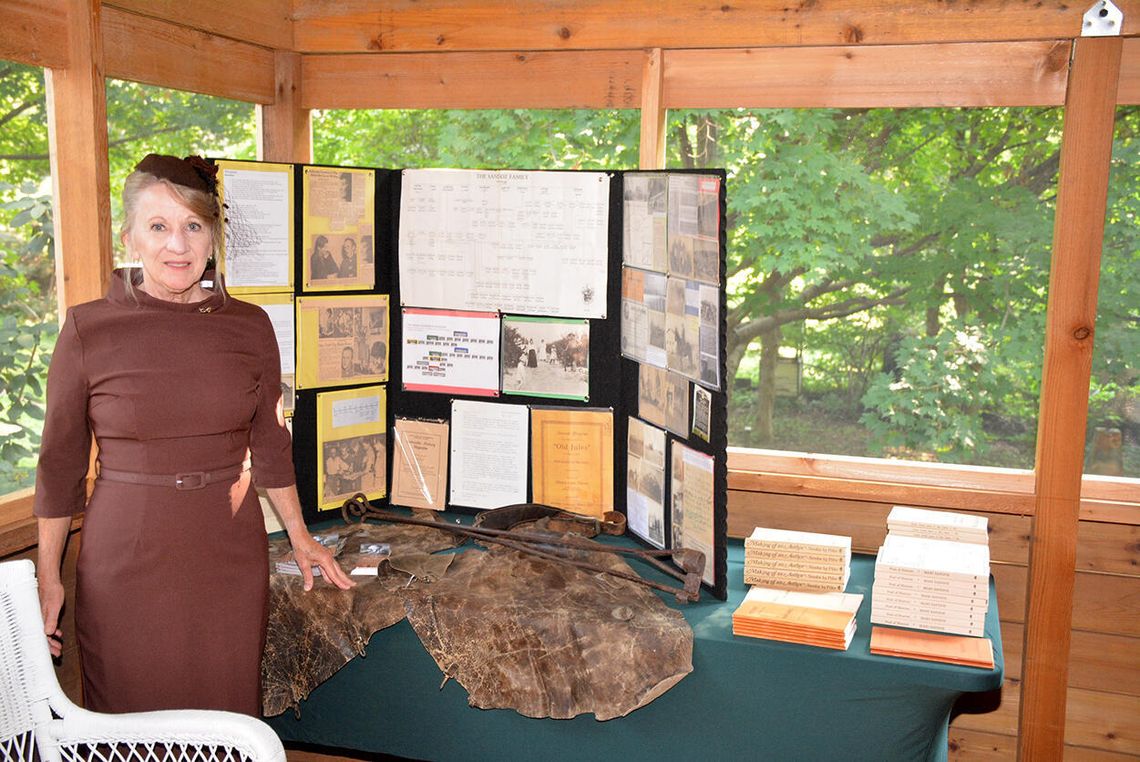
Nemaha Valley Observer photo by David Swanson
PLEASE LOG IN FOR PREMIUM CONTENT. Our website requires visitors to log in to view the best local news.
Not yet a subscriber? Subscribe today!