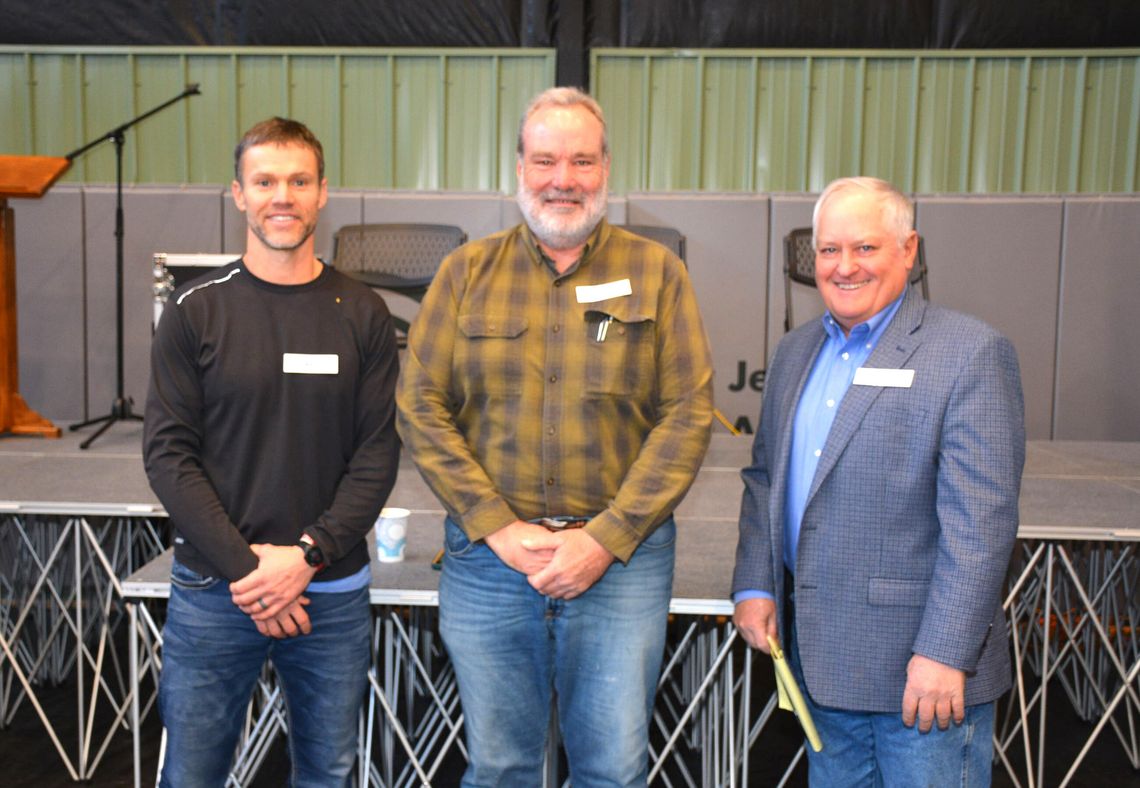
Three Southeast Nebraska producers shared their journey towards regenerative agriculture at the Southeast Nebraska Soil Health Conference in Auburn.
Lynn Meyer of Johnson, who farms south of Talmage; Mark Caspers, who farms southwest of Auburn and Mark Knobel, who farms north of Fairbury, recalled their experiences.
Particulars on regenerative agriculture are in an accompanying short article.
Meyer
He indicated he started in 2021 after returning to Nebraska. He has 35 acres organic land, 16 acres continuing transition to organic with 24 acres of pasture and grassland.
“It’s been a learning experience. I went down the route of soil health,” Meyer continued.
Steps in moving towards regenerative farming included listening to webinars, working with Nebraska Extension representatives, visiting websites, attending field days and networking with farmers.
“Talking to those who do it locally is the best networking,” Meyer stated.
Six Soil Health Principles: 1. Context: restoring landscapes and rebuilding wildlife. 2. Minimizing soil disturbance which Meyer termed important, the goal is to decrease weed pressure which is part of the farming operation until there is less soil disturbance. 3. Living roots in the soil, cover crops. 4. Biodiversity, different microbes feeding off roots annually, crop rotation and seed treatments are important. 5. Keeping the soil covered. 6. Integrating livestock.
“I’ve learned a lot of successes, including tillage, compost/extraction and seed treatments, cover crops and soil testing. There are items I want to try again or experiment with,” Meyer concluded.
Caspers
The Auburn area producer recalled his father realized no till was a part of the future.
“Every year is different. The best luck is taking the crop off in transition from alfalfa to corn. In 1995 I decided I wanted to be a no till farmer. No till worked well for us. I’ve learned as I go. I’ve made a lot of mistakes. I’ve learned what doesn’t work and learned what we think will work,” Caspers stated.
He related about getting good soil and trying to build up the organic matter in it. Caspers talked about diversity, including small grains. There is not a lot of winter wheat left in Nemaha County, he noted.
Herbicides are a big challenge on cover crops, he recalled.
“I’ve integrated a lot of clover and alfalfa into my operation. Alfalfa is the best margin crop I have, but it is labor intensive and do not do a lot of acreage. I am a believer in diversity and rotation. I work on relay cropping, including planting soybeans into wheat,” Caspers said.
“Every year is different. There’s no substitute for the good Lord and what he can do for your crops. You learn as you go,” he concluded.
Knobel
The president of Knobel Seeds has been in the seed business since 1980. Knobel has an irrigated and dryland farm and has used no till primarily since the mid-1980s.
“I believe in crop diversity and rotation. Every farmer is a conservationist,” he related.
In five years, Knobel has grown a rotation of corn, soybeans, winter wheat and double crop sunflowers. He recalled sunflowers came in to try and generate winter wheat a little more money. Livestock can generate revenue with cover crops. The producer started sunflowers at the northern edge of soybeans 25 years ago.
“I’ve had more success with sunflowers than soybeans. It does not take a lot of extra equipment to do sunflowers. Weed control is a big deal. We get less moisture in the Fairbury area than the southeast corner. We harvest in mid-November. We rarely start by Nov. 10 but usually wrap up by Thanksgiving,” Knobel continued.
“Sunflowers are not for everybody. They’re a thin market. From a soil health perspective, it’s like wheat in a rotation. Erosion is a big deal. We have heavy clay soil in Jefferson County. Sunflowers are a different crop for biodiversity. Sunflowers have been made a permanent crop on our dryland acreage,” he concluded.
Ad

Panelists Relate Soil Health Pathways at Auburn Conference
PLEASE LOG IN FOR PREMIUM CONTENT. Our website requires visitors to log in to view the best local news.
Not yet a subscriber? Subscribe today!