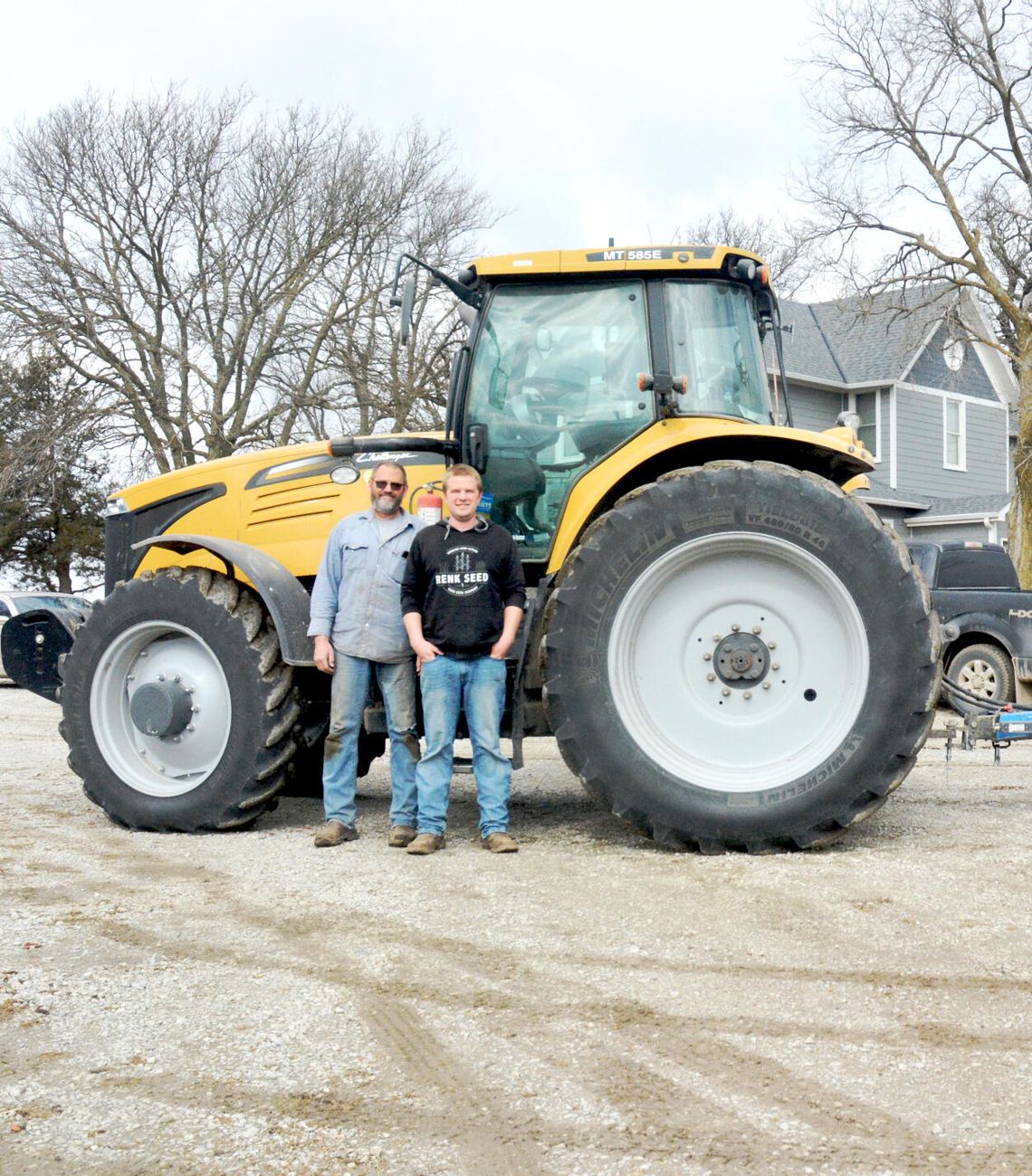
Jim and Kyle Dieckgrafe consider themselves to be average farmers in the Johnson County area.
Jim and his wife, Susan, live south and east of Cook and currently farm approximately 1,200 acres of land. Their son, Kyle, currently lives on the home place where Jim grew up, less than five miles away. Kyle farms approximately 1,000 acres of land.
Jim likes farming because there is always something to do. “You never get bored. If you do get bored, then it’s your own fault.”
Kyle, who has been farming his on his own since 2012, said, “I like being outdoors and growing crops.”
Kyle began farming through an FSA (Farm Service Agency) program known as the Beginners’ Farming Program, which really helped with land loans. Kyle also attended Southeast Community College in Beatrice where he completed the Ag Crops program.
Jim helped his father, Eldon Dieckgrafe, on his farm for his whole life. Jim’s brother, Jerry and sister, Janet also helped on the farm when they were all kids.
Jim remembers his father telling about seeing his first airplane fly across the sky while he was shelling corn. Eldon was so amazed at seeing the airplane fly over that he slipped and fell off the corn cob pile.
Another story that Eldon shared with Jim and Kyle was the day he had to make several trips in the corn field for bundling the corn because it was cut too short. Unfortunately, there wasn’t enough corn to feed the horses.
Jim has raised hogs and cattle as well as crops of alfalfa, wheat, corn, soybeans, milo and clover.
He said there are always livestock chores to do. Depending on the season, there is planting of the crops, the necessary field work that goes along with the growing season, and the harvesting of crops.
Kyle doesn’t raise livestock, but he produces crops of yellow corn and soybeans. he enjoys watching the crops grow. He enjoys scouting the fields during the growing season to observe the agronomic aspects of farming and then, during harvest season, Kyle enjoys seeing how all of his hard work has paid off.
Kyle notes that farming has become more technology based. “There is more precision due to all the data that is now collected on the types of crops, types of soil and soil temperature, and moisture, as well as the amount of fertilizer needed for crop growth, compared to farming practices 15 years ago. Farming practices may have improved significantly, however there are still maintenance issues such as machinery breakdowns and repairs that we still have to deal with on a daily basis.”
Kyle explained that most tractors today have auto-steering, but the Dieckgrafes haven’t tried farming with self-driving tractors or combines that can go from point A to point B without anyone being in the cab.
“Today you know everything about seed spacing, soil temperatures organic pH, and soil censors so you can adjust planting rates by following a map that shows the good spots as well as the bad spots in a field for growing crops,” said Kyle, adding that it is difficult to market your grain successfully. “If grain markets are volatile, you don’t get paid enough for your investment.”
Jim also stated that today’s farming practices consist of more computer technology work in compiling necessary data for producing the best crops, in addition to the manual labor a farmer puts into his work on a daily basis. There are also more insect diseases in crop production today due to the fact that there isn’t enough crop rotation.
The first tractor Jim farmed with was an Oliver 1650. Jim purchased his first tractor at the age of 10; it was an International A. He now farms with a Gleaner combine that has an eight-row corn head and a 30-row soybean head.
Jim can still remember stacking hay by hand, bundling square hay bales on hay racks and then putting the bales on a grain elevator to the hay loft so the bales could be stacked in the barn by hand. Today, he uses a large square baler on about 30 acres of alfalfa. He rents his fields of corn stalks to horse and dairy cattle producers for their horses and cattle to graze on in the fall after the harvest is completed.
Kyle remembers facing a terrible drought during his first year of farming in 2012. “The input costs were really rough. You had to borrow money cheaply.”
Through the years, Jim has faced several tornadoes and hailstorms in addition to periods of drought and flood. In 2022, the Dieckgrafes had to replant their soybean crops due to hail damage. There have been many challenges through the years.
“Sometimes you have to make cutbacks and you’re not always sure what those cutbacks should be,” Jim said.
Jim feels that the most rewarding experience about farming is when your son wants to come back and farm with you.
Kyle added, “Having good crops and good prices is also a rewarding experience. It’s satisfying seeing the fruits of your labor, knowing you tried your best and it actually worked out.”
Ad

Having Your Son Come Back to Farm With You is Rewarding Experience for Dieckgrafe
PLEASE LOG IN FOR PREMIUM CONTENT. Our website requires visitors to log in to view the best local news.
Not yet a subscriber? Subscribe today!