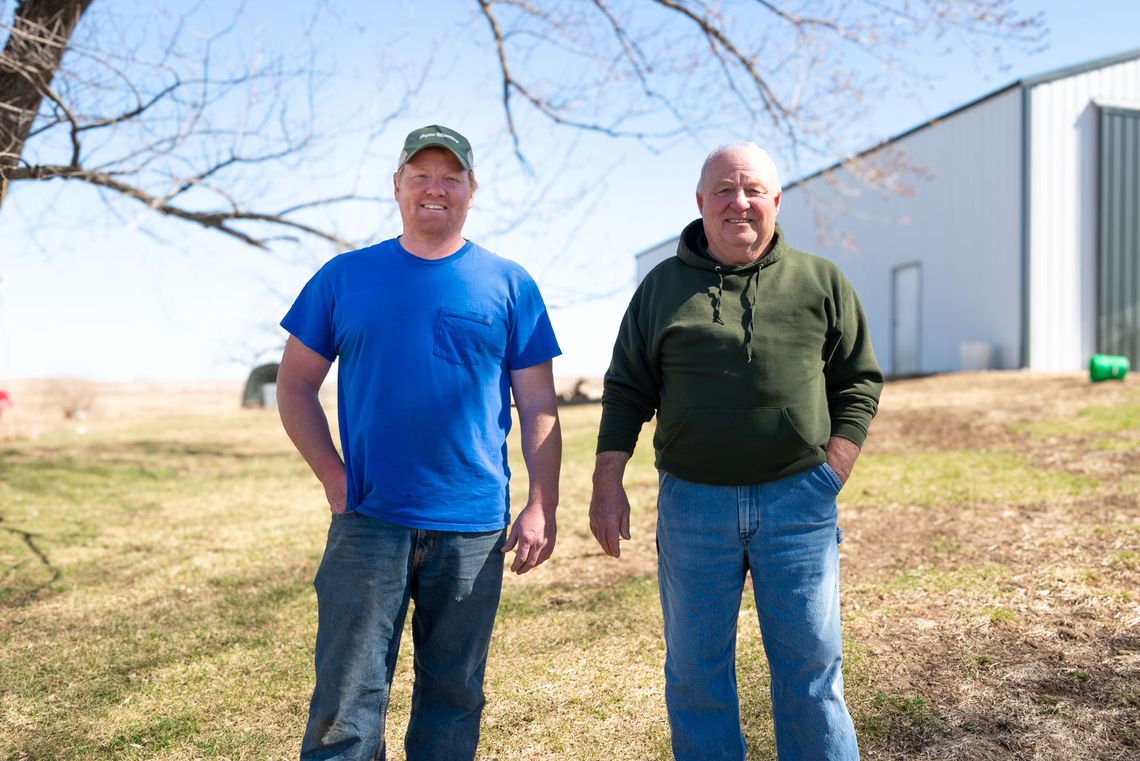
For more than 150 years, the Knipe family has worked the same stretch of land in Nemaha County, adapting to changing times while maintaining a commitment to a way of life passed down through generations.
The farm, established around 1873 by William Knipe, received the 150-Year Heritage Farm recognition from the Aksarben Foundation and was honored at the Nebraska State Fair in August 2025.
To qualify for the recognition, a farm must remain in the same family for at least 150 years and be passed down through successive generations.
“We’ve been here 150 years, and we’re planning to be here another 150,” Chuck Knipe said.
Family history traces back to Chuck Knipe’s great-great-grandfather, William, who first settled in southeastern Nebraska after operating one of the state’s early flour mills near Dawson along the Big Nemaha River. In the early 1870s, he moved his family north and purchased the land that would become the Knipe farmstead outside of Auburn.
Since then, each generation has found its own way to sustain the farm.
“The Knipe family went through tough times in the 1930s,” Chuck Knipe said. “My grandfather had a milk contract with Roberts Dairy, so he milked quite a few cows, and that helped them get through the Depression.”
Over the years, livestock and crops have shifted as family members adjusted to economic conditions and personal interests. For Chuck Knipe, that niche was hog production.
For his son, Klark Knipe, the focus is sheep. Klark is the latest generation to live on the farm.
“I don’t mind hogs, but after growing up with them, I wanted to try something different,” Klark said with a laugh. “Let’s just say it gives the place a different aroma.”
Chuck and his wife Barb moved to Auburn a few years ago. Klark now lives on the farm with his wife Brandi and children and has gradually taken on more responsibility for the operation. Before returning to agriculture full-time, he spent time as an educator.
“I taught for 11 years and then transitioned into farming,” he said. “It’s been a good change. There are ups and downs, but every day you get to work outside and do something meaningful.”
While the foundation of the farm remains the same, the methods continue to evolve.
The Knipes have begun incorporating conservation-focused practices such as no-till farming and cover crops to embrace regenerative agriculture.
“It’s definitely a learning curve,” Klark said. “We’ve been doing cover crops for about three or four years now, mostly turnips and rye. Every year, you learn a little more about when to plant and when to terminate them.”
The crops also provide feed for the farm’s livestock.
“The sheep will eat a lot of it, so it’s good for them and the ground,” he said.
Like many farmers, the Knipes also face increasing uncertainty tied to global markets and rising input costs like fertilizer or diesel.
“There’s a lot of volatility now,” Chuck said. “When I started farming in the 1970s, if corn moved 15 or 20 cents in a year, that was a big change. Now it can move three or four dollars a bushel, up or down.”
Those swings make diversification and market strategy increasingly important.
“We try different things — livestock, crops — to limit risk as much as possible,” Klark said.
Despite the challenges, the family hopes the next generation will continue the tradition. Klark’s 14-year-old son, William, already shows an interest in the work, helping with animals when sports schedules allow.
For Chuck, the longevity of the farm has only deepened its meaning. The Knipes farm about 2000 acres of crop-producing land and 100 head of hogs, down from 2000 in their heyday.
“It’s just a way of life,” he said. “And the longer it stays in the family, the more important it becomes to keep it going.”
Ad

Knipe Family Marks 150 Years on Same Nemaha County Farm
PLEASE LOG IN FOR PREMIUM CONTENT. Our website requires visitors to log in to view the best local news.
Not yet a subscriber? Subscribe today!