What began as a geologic anomaly spotted from the air in 1970 is now moving closer to becoming one of the nation’s only domestic sources of niobium and transforming the area with mine portal construction starting.
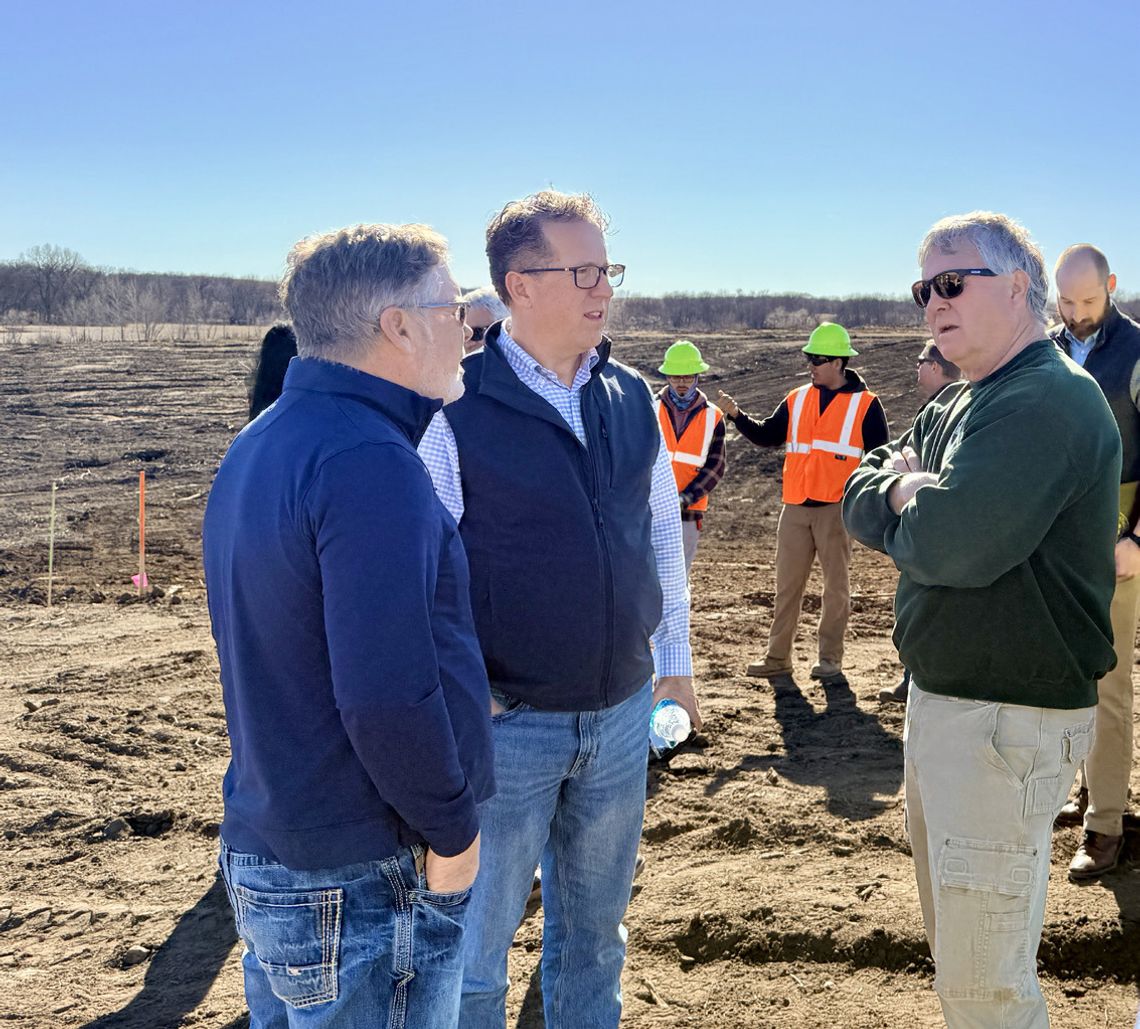
Project officials this week outlined the history and next steps for the Elk Creek critical minerals project, where crews have begun early work on the underground mine portal. On hand for the update were area officials, NioCorp executives as well as Congressman Adrian Smith of the US House of Representatives from Nebraska’s 3rd District.
Scott Honan, NioCorp chief operations officer, said the deposit formed roughly half a billion years ago following volcanic activity, when the area was later covered by a shallow sea that deposited thick limestone layers. A glaciation event about 10,000 years ago left behind the soils now farmed above the mineral deposit.
Today, the targeted carbonatite formation lies roughly 600 to 2,000 feet below ground.
Discovery dates to 1970 survey
Interest in the site began in 1970 when researchers from the University of Nebraska–Lincoln conducted an aerial geophysical survey. Instruments towed behind an aircraft detected a magnetic and gravitational anomaly roughly four miles in diameter.
A follow-up drill hole in 1971 confirmed the presence of carbonatite about 600 feet below the surface. Lavon Heidemann, former state senator, lieutenant governor and neighbor to the mine was on hand to see the progress.
“I helped drill that first hole, this has been a long time coming and we are all very excited to see the impact,” Heidemann said.
In 1973, Molycorp assembled land leases and began exploration. By 1978, drilling confirmed concentrations of niobium in the core samples. Additional work through the late 1980s established the presence of a viable deposit.
However, development stalled for years as the company focused on a larger, higher-grade niobium operation in Brazil.
Momentum returned in the mid-2000s when the current developer assembled new land holdings and resumed exploration. The project’s first full feasibility study was published in 2017.
Officials said optimization work has continued since then, with the final study expected to be completed this year.
Portal construction underway
Work now underway focuses on constructing the mine portal — the primary underground access point.
Crews are excavating a large wedge-shaped opening to reach the limestone bedrock. Jake Whitefoot of Gana Trucking is on the team leading the dirt work.
He explained that his team got started in the last two days, “the portal will be about 600 feet wide and go about 150 feet down. We’ll remove about 300,000 cubic feet of dirt. We’re creating run off basins around to control silt as well.”
From there, drill-and-blast work will create a vertical face where two underground tunnels will begin.
Project leaders estimate construction of the underground mine and surface plant will take about three years, with potential production beginning around 2029. NioCorp hopes to have complete financing by this summer as well as upgrades such as turn lanes to Highway 50, 62 and 721 road. A project NioCorp has built into their budget.
“It’s taken a long time to get to this point, but we finally have some traction,” Honan said.
Four primary products planned
At full operation, the underground mine is expected to extract about 1 million tons of rock annually. Refining will be done on site at a planned 10 story facility with a footprint of roughly 750,000 square feet.
The primary product will be ferroniobium — a steel-strengthening additive used in automobiles, bridges, buildings and medical equipment. Officials noted there is currently no domestic niobium production in the United States.
Additional planned byproducts include: Scandium oxide used to strengthen lightweight aluminum alloys used in aerospace and defense, Titanium for metal and pigment products, and rare earth materials used in permanent magnets for electric vehicles and wind turbines.